
Angels at Mass in the liturgy are understood in Scripture and Christian tradition as heavenly ministers who surround the altar, join in praise, and attend sacramental action—reminding worshippers that the Eucharist participates in a heavenly liturgy where human prayer and angelic worship converge in offering thanks and communion to God.
angels at mass in the liturgy — have you ever noticed the quiet that seems to hold the sanctuary just before the Eucharist? Scripture and tradition offer glimpses of a heavenly presence that invites our wonder and reverent attention.
Angels in scripture: scenes of worship and liturgy
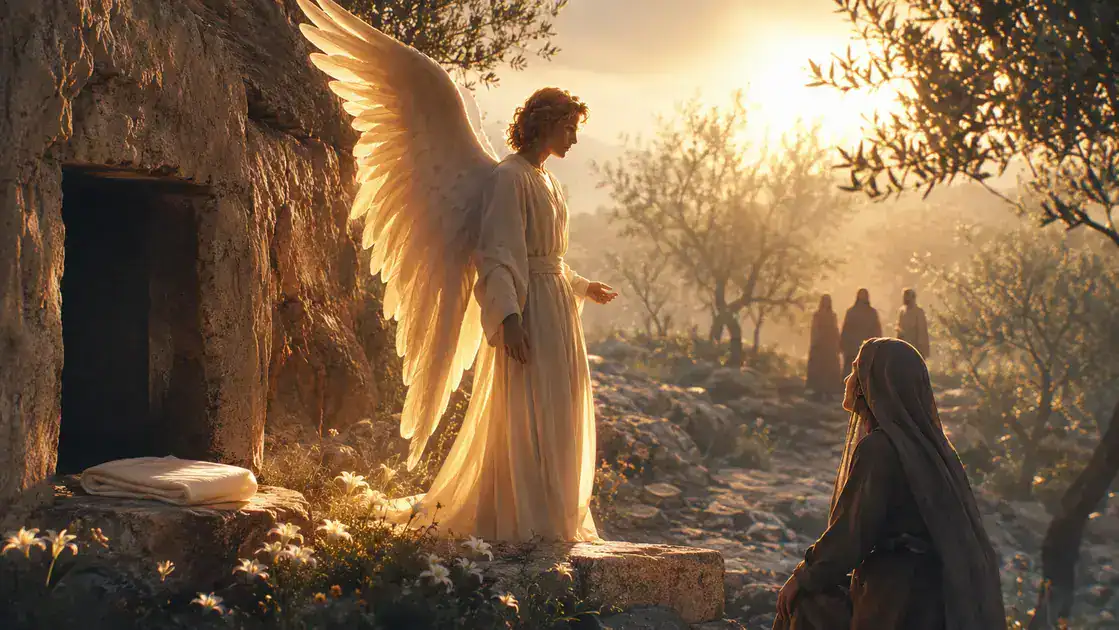
A hush like incense often fills the pages of Scripture when heaven meets earth. In Isaiah’s great vision, the prophet sees the Lord enthroned and seraphim calling, “Holy, holy, holy”, their wings stirring the temple with a sacred rhythm. That scene gives us a picture of worship that is both awe-filled and intimate, where creatures of light attend the throne and call creation back to praise.
The New Testament carries the same music into the life of Jesus and the early church. Angels announce the birth of Christ, stand ready to serve him in the desert, and in Revelation they circle the throne offering unending praise to the Lamb. These images shape a sense of liturgy as a meeting place between human voice and heavenly song, a shared act of worship in which earth and heaven respond together.
When we hold these texts in our hearts, the Mass begins to read like those sacred scenes. The gestures, words, and silences of the liturgy echo the heavenly court, inviting us to join a larger song. This is not merely poetic language but a lived hope: that in our small, ordinary acts of worship we participate in the same praise the angels offer before God.
Theological foundations: angels in the sacramental economy
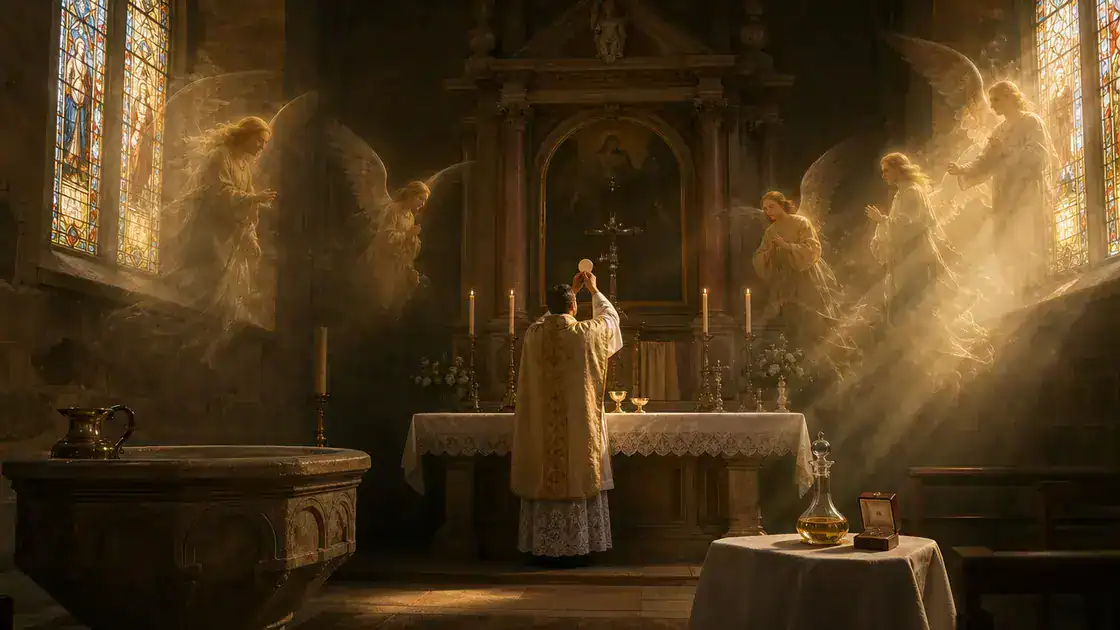
The Church has long held that angels share in God’s work through the sacraments. Scripture shows them as worshipers and servants who stand before God and move among his people, and the Church’s prayer life reads the liturgy as a meeting of earth and heaven. In this light, the sacramental economy becomes a visible sign of an invisible reality where grace is given and received with both human and heavenly attention.
Think of the Mass as a doorway into that larger worship. Revelation and Hebrews picture angels around the throne offering praise, and many liturgical prayers quietly recall that same heavenly liturgy. Imagining angels near the altar helps us see the Eucharist not only as a human action but as participation in an eternal praise that includes created spirits.
Beyond the Eucharist, angels attend other sacraments too—baptism’s water as a sign of new life, anointing’s gentle touch in sickness, and the vows of marriage witnessed by a heavenly court. Their service never removes our freedom; rather they act as ministers of God’s care, drawing us to humility and wonder. Remembering them can deepen our reverence and invite a quieter, more attentive way of receiving the sacraments.
The eucharist as heavenly banquet: Revelation and imagery
The book of Revelation paints the Mass as a glimpse of a great feast. John sees a throne and the Lamb, and around the throne a vast company sings. That image gives us a sense of the heavenly banquet where angels and saints share one table and give continual praise.
At the altar we use bread and wine to meet that vision. The Eucharist points to the same meal the Lamb prepares, and when the bread and wine become Christ’s body and blood, we do more than remember. We join the local assembly and the choir of heaven, a quiet but real participation in heavenly praise that reaches beyond our own eyes and ears.
Holding this image gently shapes how we arrive and how we receive. Movements become calmer, silence deeper, and our hearts more open to wonder. The thought of angels around the table helps us see that our simple acts of faith fit into a larger, holy feast and invites a reverent attention as we come to the communion table.
Liturgical moments where angelic presence is invoked
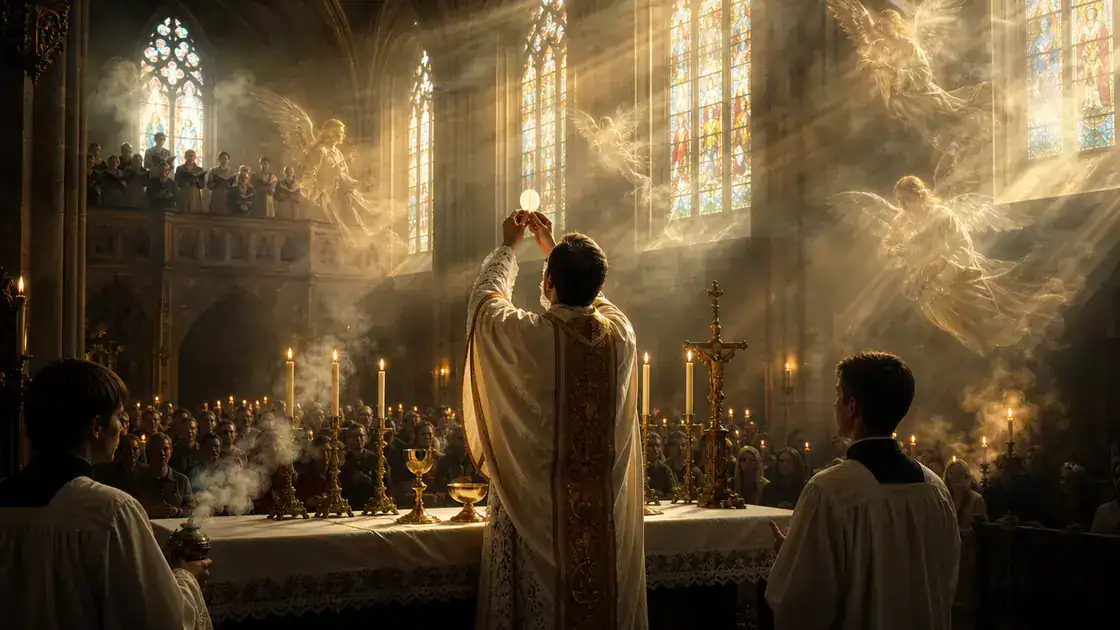
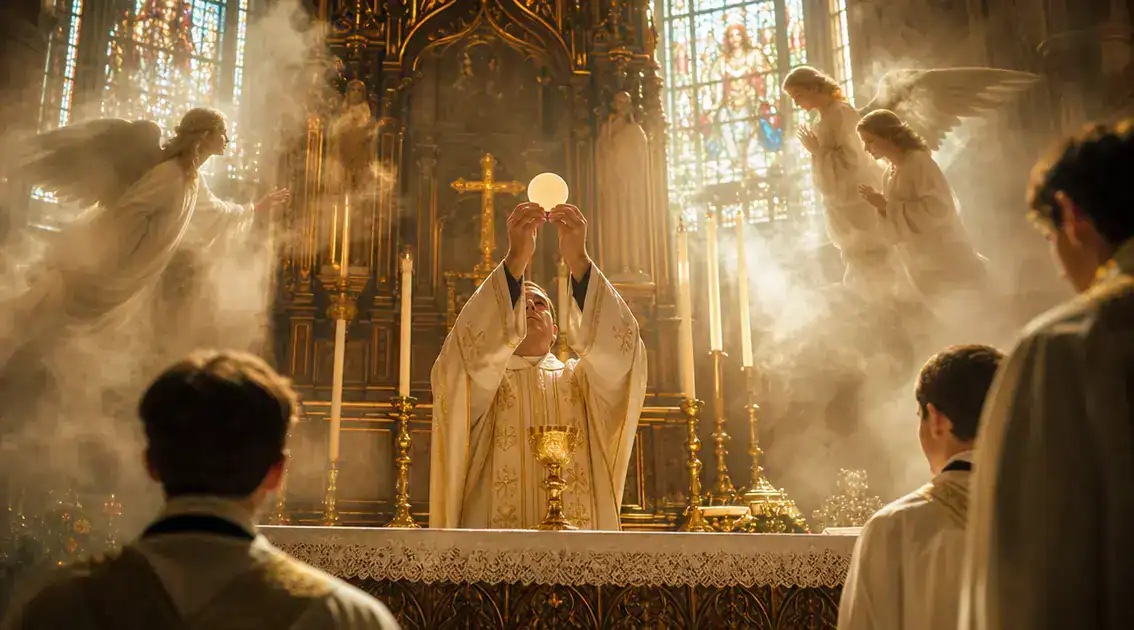
The Mass gives us clear moments where heaven seems to press close to earth. The congregation’s cry of the Sanctus draws directly from Isaiah and Revelation, naming God’s holiness as the angels do. In the Preface the celebrant often invites us to join “with the angels and archangels,” a short line that quietly reminds us the liturgy is more than a human prayer—it is a shared act of praise with the heavenly court.
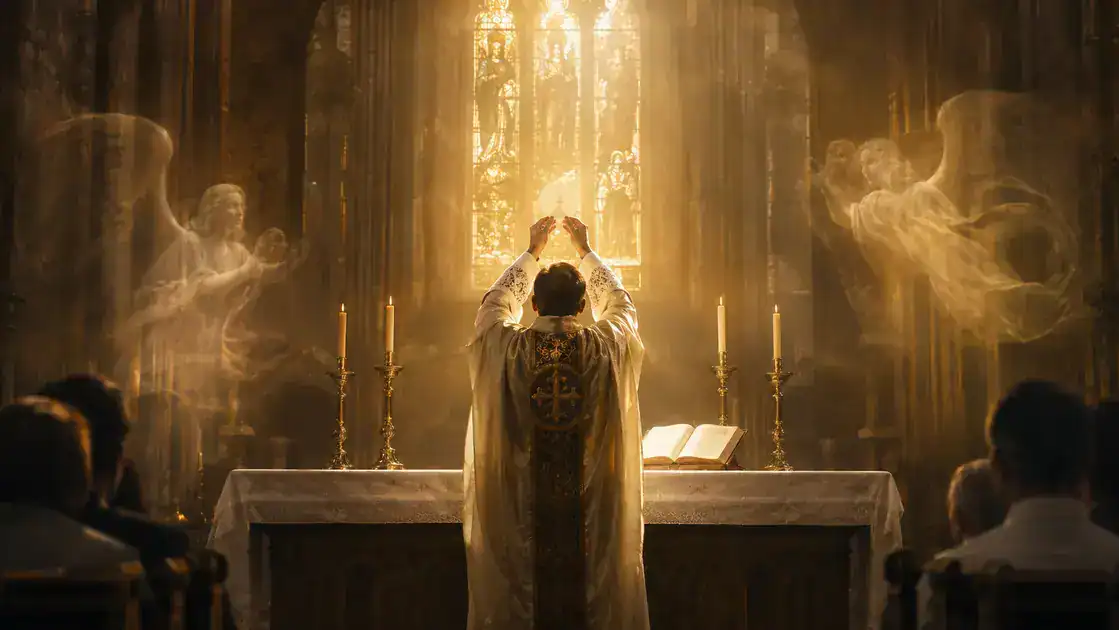
Liturgical gestures and senses also call angels to mind. Incense rising toward the dome, the solemn ringing and the priest’s elevation of the host at consecration make the moment feel lifted beyond the room; these signs echo the heavenly worship and suggest the presence of unseen attendants. In the Eastern rites, the cherubic hymn explicitly names the mystical role of angels, asking the faithful to represent the cherubim in spirit as the bread and wine become Christ’s body and blood.
Outside the Eucharist, other rites and prayers recall angelic care—baptismal rites speak of new life guarded by unseen hands, funeral prayers entrust the dying to the company of angels, and simple devotions bring the faithful into conscious awareness of heavenly accompaniment. Such moments do not replace the work of grace given by God, but they shape how we stand before it: quieter, humbler, attentive to the sense that our worship participates in a larger, sacred chorus where angels, saints, and the living join together.
Ritual texts and prayers that recall heavenly participation
Liturgical words often open the door to heaven by naming what Scripture already shows: the angels stand before God and cry out in praise. In the Mass the congregation sings the Sanctus, and the celebrant’s preface will frequently call us to join “with the angels and archangels” in giving thanks. These brief lines are small but powerful: they invite us to imagine our prayer as part of a larger, heavenly song that has been sung since Isaiah’s vision and John’s revelation.
Other ritual texts make the same move in different ways. The Eastern Church’s cherubic hymn asks the faithful to “represent the cherubim” as the bread and wine are offered, while baptismal and funeral rites speak of angelic care surrounding new life and final passage. These prayers do more than decorate the liturgy; they shape how we listen and how we stand. When the words call the angels, our gestures, silence, and voice begin to answer them.
Learning to attend to these texts can change our worship from habit into wonder. A simple pause, a deeper breath before the Sanctus, or a mindful genuflection lets the prayer sink in and helps us sense that we are joining a host beyond the room. Such small acts do not prove visions of angels, but they open the heart to participation in heavenly praise and to the reverent attention the liturgy seeks to form in every worshipper.
Devotional experience: sensing angels during Mass
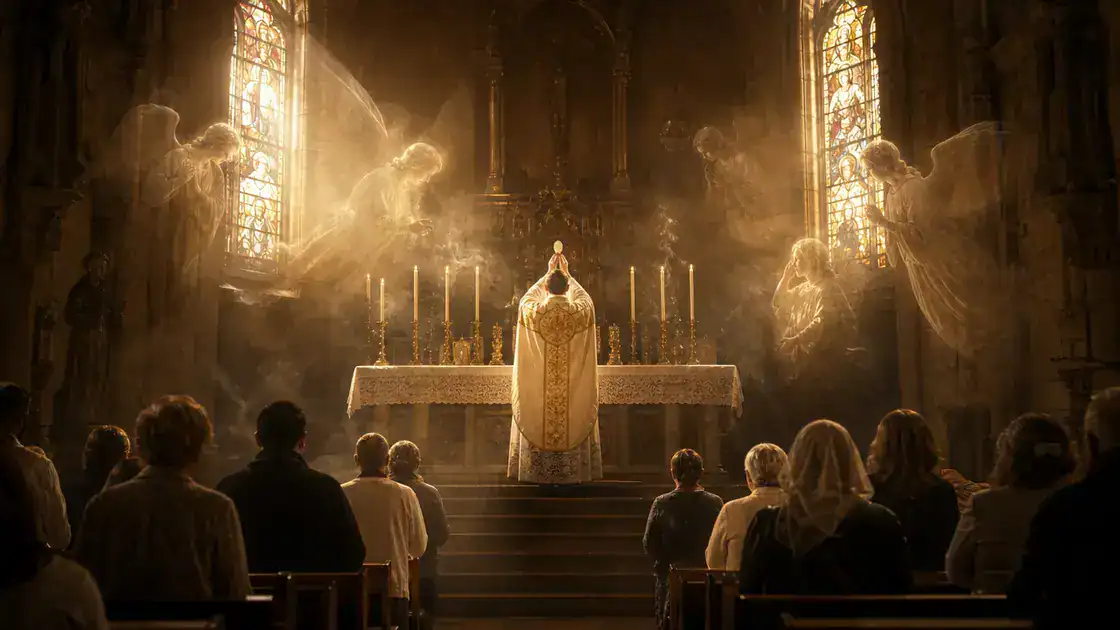
There is a hush that falls in the church when the congregation grows quiet and light slants through the windows. In that stillness some worshippers feel a gentle warmth or a soft lift, as if they are not alone. These quiet moments can feel like a small sharing in what Scripture pictures as the song of heaven, and the sense of angelic accompaniment usually arrives as calm rather than spectacle.
Many saints and ordinary faithful have described this same sense in simple terms—a comfort at the foot of the altar, a steadiness in prayer, a sudden clearing of the heart. Scripture gives room for such experience, from the seraphim who cry “Holy” in Isaiah to the angels who surround the throne in Revelation. These images remind us that the liturgy opens a space where heaven and earth meet, and the felt presence of unseen companions can be a quiet fruit of that meeting.
We can tend to this awareness by slowing our gestures, listening to the silences, and letting liturgical signs like incense, a bowed head, or the elevation of the host speak to our hearts. It helps to seek humble attention rather than dramatic proof; reverence and communion are the aims, not visions. When we come with steady, simple faith, the Mass itself can teach us how to live in the company of both saints and angels.
Pastoral practice: cultivating reverence with an awareness of angels
Pastoral leaders can help people notice the sacred by naming the presence that Scripture and tradition speak of. Simple catechesis about the Mass and its language can open hearts to an awareness of angels without making worship feel strange. When clergy and catechists teach the meaning of the Sanctus, the Preface, or the gestures at the altar, they give families a gentle framework to stand more fully in reverence.
Small, practical habits foster that reverence. Encourage moments of silence before Mass, quiet music that draws attention inward, and clear explanations of signs like incense, genuflection, or the elevation of the host. Teach children short prayers and gestures—simple acts that form lifelong habits—so that the whole assembly learns to listen for the sense of being joined to a larger, heavenly worship.
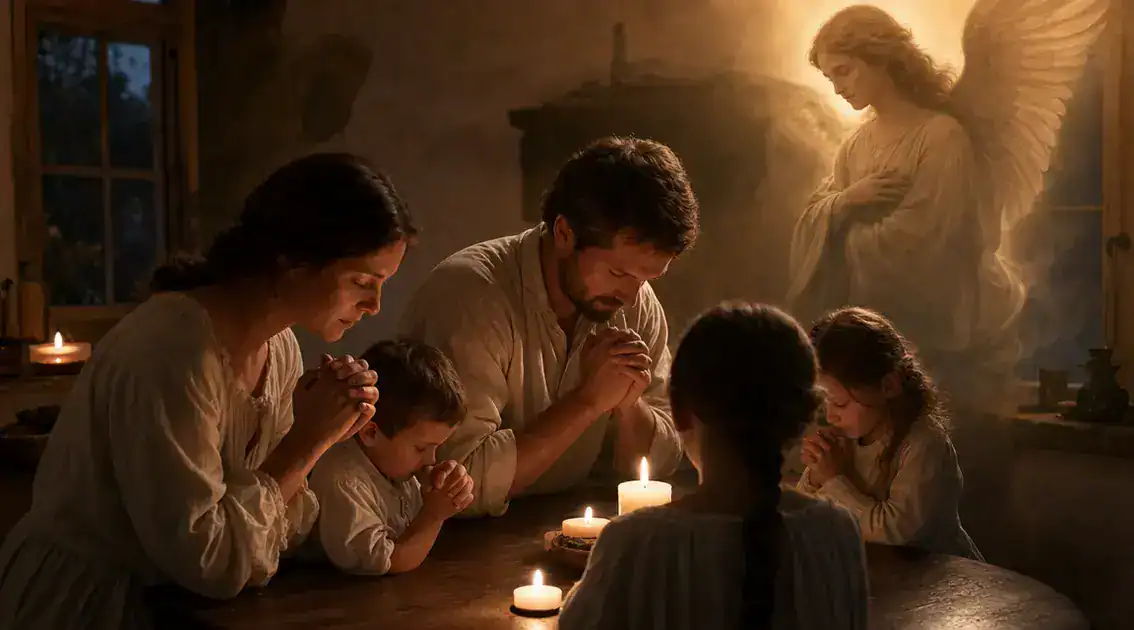
At the same time, pastoral care must avoid seeking dramatic experiences. The aim is steady, humble attention rather than spectacle. Invite personal devotions like the guardian angel prayer, provide sacred art and music that point upward, and model calm liturgical posture. Over time, these small practices help a community live with greater wonder, receiving the sacraments as a shared encounter where human praise meets the praise of angels.
A gentle prayer as we leave the altar
As we step back into ordinary time, may we remember that we are not alone—we go in the company of angels and saints who join our praise. The liturgy has shown us a small window into heaven, and that sight can keep our hearts quiet and full of wonder.
Let small habits keep this sense alive: a brief moment of silence, a mindful sign of reverence, a simple prayer for help before the day begins. These acts do not demand visions or signs; they teach us to live with an open, humble heart.
May God send gentle guides in the unseen ways we need, steadying our steps and sharpening our praise. Grant us grace to receive the sacraments with reverence and to carry that calm into our homes, work, and rest.
Go forth with peace, attentive to the holy around you. Let the memory of the Mass and the presence of angels shape the way you pray, love, and meet each new day.
FAQ – Angels, the Mass, and heavenly participation
Do angels really take part in the Mass according to Scripture and tradition?
Yes. Scripture shows angels praising God (Isaiah 6; Revelation 4–5) and calls them “ministering spirits” (Hebrews 1:14). Liturgical texts and Christian tradition read the Mass as joining that heavenly worship, so the prayers that invoke angels express a long-held belief that heaven and earth meet in the liturgy.
When in the liturgy are angels most often invoked or remembered?
They are named in the Sanctus and many prefaces that invite us to pray “with the angels and archangels.” The Eucharistic prayer, the consecration, and moments like incense, elevation of the host, baptism, and funeral rites especially recall heavenly presence. Eastern rites likewise call to mind the cherubim during the anaphora.
Will I see or feel angels at Mass, or is their presence only symbolic?
For most people the sign of angelic presence is inward—a sense of peace, reverence, or lifted attention—rather than visions. Scripture and the lives of saints allow for both symbolic and real encounters, but pastoral tradition urges humility: cultivate reverence rather than seek dramatic signs.
Is it appropriate to pray to angels during the Mass?
No. The Mass is the worship owed to God alone. Liturgical texts invite us to join the angels in praising God, not to direct prayer to the angels themselves during the Eucharistic celebration. Private devotions or brief prayers to your guardian angel outside Mass are part of many traditions, offered always under the primacy of prayer to God.
How can I cultivate a faithful awareness of angels in parish life?
Learn the meaning of the liturgical texts (like the Sanctus and Preface), practice brief silence before Mass, attend catechesis about signs such as incense and genuflection, and teach simple prayers for children. Small habits—calm posture, attentive listening, and reverent reception of the sacraments—open the heart to the sense of heavenly company.
Do all Christian denominations affirm angels’ role in worship?
Many do, but emphasis varies. Orthodox and Catholic liturgies explicitly integrate angelic imagery; many Protestant communities accept the biblical witness to angels but may not use the same liturgical invocations. Across traditions, Scripture remains the common ground for affirming angels’ worship of God.