

When someone says “survived an accident angel saved me,” Scripture and Christian tradition understand such sparing as an instance of God’s providential care often mediated by guardian angels—created ministering spirits entrusted to watch, guide, and sometimes intervene to protect lives while respecting human freedom and calling forth gratitude and responsible discernment.
survived an accident angel saved me; Have you ever found yourself whispering those words after a narrow escape? I’ve listened to testimonies and studied Scripture that invite us to hold wonder, gratitude, and a quiet, devotional attention to what may have watched over us.
What Scripture says about angels intervening in danger
Scripture often shows angels stepping into dangerous moments with surprising tenderness. In many passages they appear not as distant forces but as God’s hands at work close to human life. Psalm 91:11–12 is one verse people turn to when they feel spared, promising that God commands his angels to guard the faithful in all their ways.
The narratives make this promise concrete: an angel is said to have shut the mouths of the lions to protect Daniel, an angel wakes Peter and leads him past sleeping guards, and angels urge travelers to flee before a city is undone. These stories are simple and vivid. They remind us that divine help in danger is portrayed as personal, timely, and woven together with human trust and obedience.
Hebrews 1:14 calls angels “ministering spirits,” which invites a humble, reverent view of their work: they serve God’s purpose, not their own. That means when we read of angelic intervention we can stay both thankful and sober—grateful for protection, careful not to make angels a superstition, and open to the mystery of providence that Scripture holds before us.
Biblical cases of avoided death: from Daniel to Acts
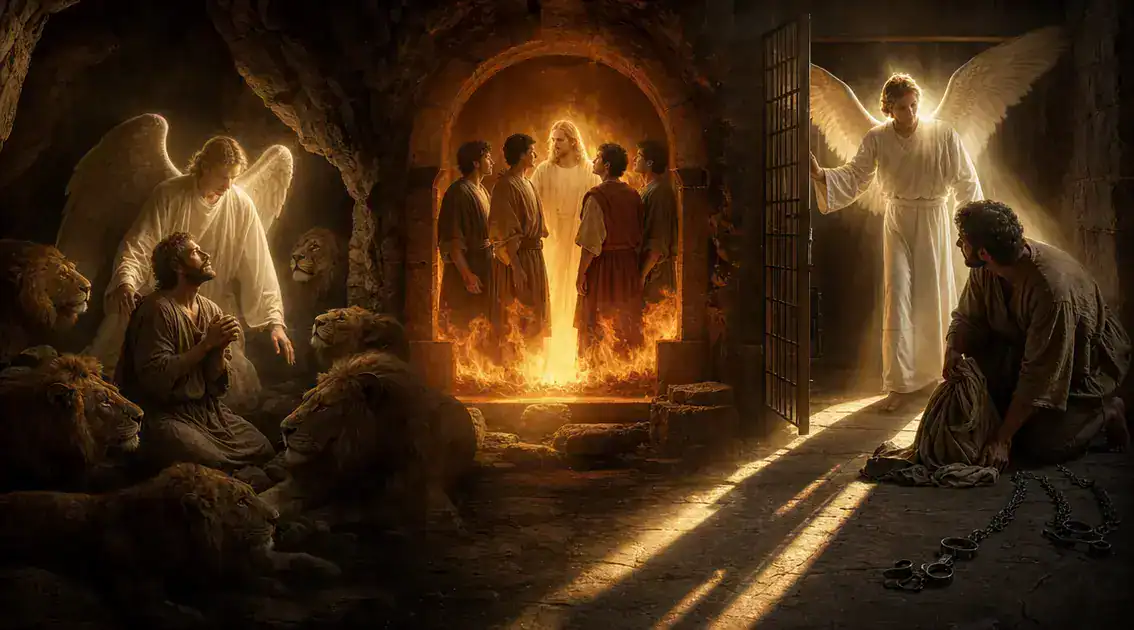
In Daniel’s story a man is lowered into a den of lions and the scene feels both terrifying and still. Scripture says God’s presence intervened and the lions’ mouths were shut, leaving Daniel unharmed, a quiet sign that danger can be met by a tender power. This episode invites us to hold the image of rescue not as spectacle but as the calm arrival of help when human hope is nearly gone, and to see faith met by deliverance.
Close beside that memory stands the furnace where Shadrach, Meshach, and Abednego were bound and the flames roared. The text names a fourth figure with them — a presence that did not burn but stood in the fire — showing that God’s help can be intimate and bodily, sharing the trial rather than avoiding it. Their experience teaches that angelic or divine accompaniment often means company in suffering, turning a moment of doom into a lasting testimony to God’s faithfulness.
The Book of Acts continues the same gentle pattern: an angel wakes Peter and leads him past sleeping guards, and elsewhere a heavenly word comforts Paul amid a brutal storm at sea. These stories are not identical, but they form a single thread across Scripture: when people face real peril, God sends help that is timely and personal. Taken together, these passages encourage a reverent trust that God’s ministering care can meet us in danger and guide us back toward life.
Theology of guardian angels: purpose, dignity, and limits
Christian theology teaches that guardian angels serve a clear, humble purpose: they act as ministering spirits sent to help those who will inherit salvation. This idea appears in Scripture as a steady thread—angels bring messages, guard travelers, and offer comfort in trials. When we speak of their purpose, we stay close to the simple truth that their work points us back to God’s care rather than to themselves.
At the same time, angels possess a dignity that asks for reverence but not worship. They are created beings of beauty and order who reflect God’s glory and stand in his service. Recognizing their dignity means honoring their witness and the comfort they bring, while remembering that worship belongs to God alone and that angels exist to lift our hearts toward the divine.
It is equally important to name their limits: angels do not make us do things nor do they replace human freedom or God’s providence. They operate under God’s will, within the boundaries of his plan, and often in subtle, unseen ways. A healthy devotion to guardian angels grows from gratitude, prayer to God, and responsible discernment—trusting that help can come while keeping God at the center of our hope.
How saints and witnesses describe angelic rescues

Many saints and ordinary witnesses tell their stories in the same quiet way: they do not boast of miracles, they name a moment when danger lessened and a presence remained. Figures like Padre Pio and Saint Faustina are often cited because their lives drew public attention, yet their reports read like simple notes of relief — a steadying hand, a warm light, a voice that urged calm. Such accounts invite us to listen closely to the small, faithful language of rescue.
These descriptions share common features: the help is usually humble, prompt, and intimately tied to prayer or trust. People speak of being awakened, of feeling a shield around them, or of finding themselves led away from harm without fanfare. When we read these testimonies we notice a pattern of compassionate intervention rather than spectacle, which helps us hold the stories as devotional aids rather than sensational proof.
That pattern shapes how communities respond. Testimony from saints and neighbors encourages gratitude, sober discernment, and deeper prayer that points to God rather than to the angel alone. It also teaches caution: faithful witnesses urge us to avoid superstition and to keep worship directed to God. In this way, the stories become a living invitation to trust, to thank, and to remain careful about the sacred mystery we cannot fully explain.
Interpreting near-death saves: providence, free will, and mystery
Many who survive near-death moments speak of something that feels both gentle and unexpected. Scripture asks us to name that care as providence, the ongoing way God watches over fragile life. This word does not solve the puzzle, but it helps us see rescue as a part of a faithful presence that bends toward life.
At the same time, the Bible insists that our choices matter. We act, we decide, and we sometimes walk into danger. Divine help does not cancel human responsibility; rather, it meets us amid our choices and offers aid within God’s will. Keeping free will and divine care together reminds us to be humble, alert, and grateful.
Even with providence and freedom held together, a full explanation often escapes us, and that is part of the Christian path. We live with a quiet mystery about why some are spared and others are not, and that mystery calls for prayer, thankfulness, and steady community care. These practices help us respond with trust and with the careful mercy that such fragile moments deserve.
Practical devotion: acknowledging an angel without superstition

You can acknowledge a guardian angel with small, steady acts of devotion that keep God at the center. A brief prayer of thanks, the sign of the cross, or a moment of silent gratitude after a narrow escape helps name God’s care without turning the angel into a charm. Hebrews 1:14 calls angels “ministering spirits,” reminding us that their role is to serve God’s work of care and not to take God’s place.
Simple practices build a healthy devotion: speak a short prayer of thanks, light a candle in a church or at home, or share the experience with a trusted friend or mentor. These acts make gratitude visible and steady, and they teach us to respond with humility rather than spectacle. Avoid rituals or objects that promise guaranteed protection; faith is lived in trust and responsibility, not in superstition.
If you wonder whether an experience was truly angelic, bring it into community and scripture, and seek spiritual direction when needed. Let moments of being spared move you toward mercy for others—volunteer, pray for the vulnerable, or offer help to neighbors. In this way, acknowledgement becomes action, and our gratitude points back to God, for God alone is worthy of our worship while angels call us deeper into his care.
Living with gratitude: prayers, rituals, and community testimony
Gratitude after a close call often begins with a simple, steady prayer. A few quiet words—thank you, I am safe—place the experience in God’s hands and help the heart settle. These short prayers can be said aloud, whispered, or kept as a silent breath, and they teach us to name the gift without turning the moment into a show.
Small rituals make gratitude visible and steady. Lighting a candle, offering a prayer at Mass, or writing a brief note of thanks connects the inner feeling with outward acts. Sharing the story with trusted friends or a faith community gives the memory a place to live; testimony becomes a form of worship when it points back to God and moves others to hope rather than fear. In these practices we balance wonder with grounded faith.
Living grateful means turning thanksgiving into service. When a community hears stories of being spared, it often responds with care for those still in need—meals, visits, prayers, and practical help. Such action keeps our focus on God and on neighbor, teaching that true worship leads to mercy. In this way remembrance becomes a steady habit that shapes how we move through danger, comfort, and everyday life.
Walking home with a quiet wonder
When we remember being spared, let our hearts lean toward gratitude and gentle praise. Know that we are never truly alone; a faithful presence walks near, guiding and guarding in small, steady ways.
Take a short prayer with you—thank God for care, ask for help to see others, and offer your life in service. These little habits keep wonder alive and turn memory into mercy.
Share your story with someone you trust so the memory lives in community. Testimony grows hope, and caring acts help us hold mystery without fear.
May the peace that follows a spared life rest on you. May you walk with open eyes, ready hands, and a soft heart that keeps giving thanks. Amen.
FAQ – Common questions about guardian angels and sacred care
Do guardian angels really exist according to the Bible?
Yes. Scripture refers to angelic protection in passages like Psalm 91:11 and presents angels as active helpers in stories such as Daniel in the lions’ den and Acts where an angel frees Peter. Hebrews 1:14 calls them “ministering spirits,” which the tradition has long read as evidence of God’s protective care through angels.
Does every person have a guardian angel?
Many Christian traditions, especially Catholic teaching and many earlier Church Fathers, hold that each soul is entrusted to a guardian angel. Jesus’ words in Matthew 18:10 about the angels of children who behold the Father are often cited in support. Different denominations speak about this with varying emphasis, but the idea is well rooted in Scripture and long-standing tradition.
How do angels intervene in danger according to Scripture?
Biblical examples show diverse forms of help: angels can calm threats, free prisoners, or provide timely guidance. Daniel, Shadrach, Meshach, and Abednego, Peter in prison, and Paul at sea illustrate that intervention is usually prompt, personal, and directed by God. The consistent point is that angels act under God’s will to serve and protect, not as independent powers.
Can I pray to my guardian angel?
Many spiritual traditions encourage addressing your guardian angel in brief prayer as a companion and intercessor, for example the traditional Catholic prayer “Angel of God.” Such prayer should always direct worship to God alone and avoid elevating the angel. In practice, praying for guidance or thanksgiving to one’s guardian angel is treated as a devotional aid that points back to God.
How should I discern whether an experience was truly angelic?
Discernment is both humble and communal: check whether the experience aligns with Scripture, whether it leads you closer to God and charity, and seek counsel from trusted spiritual guides or clergy. Scripture also warns believers to test spirits (1 John 4:1). Genuine encounters bear good fruit—peace, humility, and increased love—not fear, pride, or confusion.
How can gratitude shape my daily life after being spared?
Gratitude can become devotional and practical: offer a short prayer of thanks, share testimony in a faith community, light a candle or give to the needy. Scripture models this in Luke 17, where the healed leper who returned to give thanks stands as an example. Turning thanksgiving into acts of mercy helps the community and keeps the focus on God’s care rather than on the sensation of the event.