

Afternoon meditation with angels is a brief, two-minute devotional pause rooted in Scripture and Christian tradition, inviting believers to breathe, recall Psalms’ imagery, and sense angelic companionship as a practical, contemplative practice that steadies the heart, sharpens discernment, and sanctifies ordinary afternoon moments.
afternoon meditation with angels — have you ever felt the late-afternoon hush as a small benediction? This two-minute pause invites you to breathe, listen, and sense gentle companionship.
Biblical moments of angelic visitation
The Bible holds quiet, startling visits where heaven touches ordinary life. Often an angel appears not in thunder but at a doorway, beside a tent, or in a dream. These scenes show a tender pattern: God reaches out through a companioning presence. Angels function as messengers of God’s presence, offering guidance, reassurance, and sometimes a call to change course.
Think of Abraham at his tent when three travelers arrive with news that seems impossible, or of Jacob who wakes from a sleep and sees a ladder where angels move between heaven and earth. In the wilderness Hagar meets an angel who sees her pain and speaks a name into her future. Each visit is simple in its details yet deep in its meaning: God meets people in fragile moments and speaks hope into their story.
In the New Testament that same intimacy appears when Gabriel visits Mary with a startling promise, or when an angel brightens a nighttime field to bring the shepherds good news. These accounts teach a living lesson: divine messages often come as calm interruptions to our day, not as grand spectacles. When we pause with quiet prayer or attentive listening, we open ourselves to those small, steady ways God calls and comforts.
How angels accompany our daily prayers
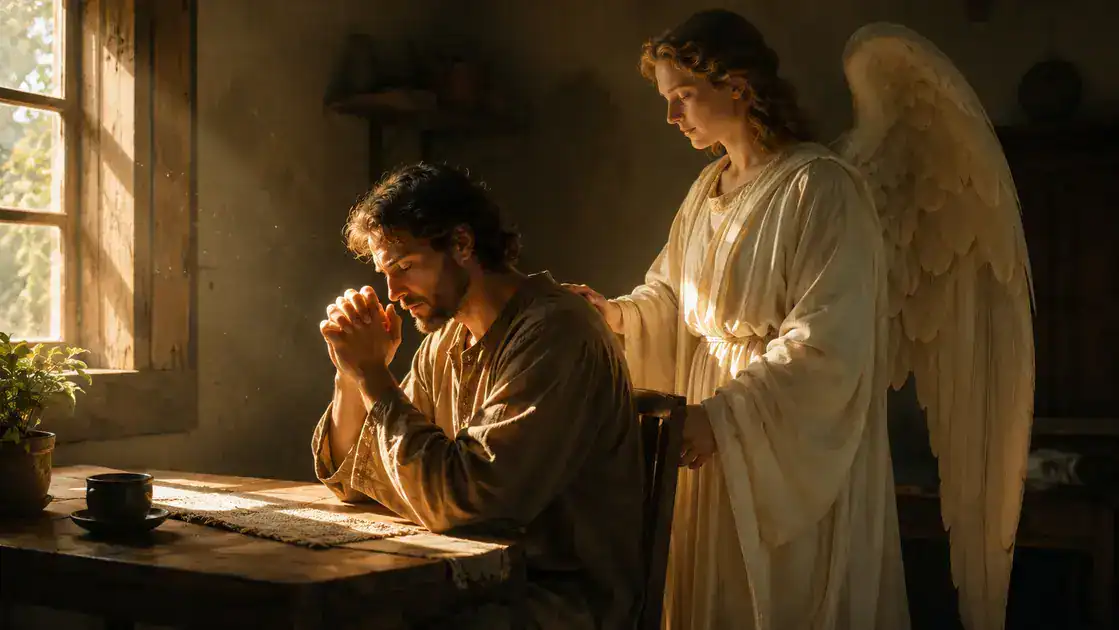
When we fold a short prayer into the middle of a busy day, we do more than speak into the air. Angels, Scripture suggests, move with those small moments and stand as gentle witnesses to our words. The psalms tell us that God’s angelic care is near — an image that helps us pray with trust, not fear. In the New Testament, angels are described as ministering spirits, sent to serve those who seek God, which gives a simple, hopeful meaning to our daily prayers.
Praying with the sense of an unseen companion changes the tone of our speech. It does not demand visions or loud signs. Rather, it invites a quieter attention: a steadier breath, an honest line spoken to God, and the soft confidence that we are not alone. Many saints and spiritual writers describe this as an ordinary grace—an added warmth around prayer that turns a single breath into a sacred encounter.
Try folding this awareness into an afternoon pause: breathe, name your need or gratitude aloud, and imagine a steady presence at your side. Let that image help you return to work with a calmer heart and a clearer mind. Over time, these short practices form a gentle habit: prayer becomes both talk with God and the quiet companionship of an angel who reminds you that each ordinary hour can hold a sacred purpose.
Two-minute guided pause rooted in Psalm imagery
Close your eyes for a moment and notice the weight of your shoulders. Picture a quiet stream and a broad, green pasture from the Psalms — simple images that slow the breath. Let the idea of a shepherd who knows your name rest beside you; this is not a vision you must earn, but a gentle invitation to breathe and be still.
Now breathe slowly: inhale for four counts, hold one, exhale for four. With each out-breath imagine the water smoothing like glass and the light warming the grass. Softly repeat to yourself a short phrase drawn from Psalm imagery, such as “He leads me beside still waters”, letting the words settle into your chest rather than your head. If thoughts come, name them briefly and return to the breath and the image of steady water.
Spend the last moments simply receiving that calm. Feel how a two-minute pause can make your hands steadier and your mind clearer. When you open your eyes, carry the memory of the pasture and the water as a quiet companion through the rest of your afternoon, a small sacred space you can return to again and again.
Saints’ encounters that teach listening
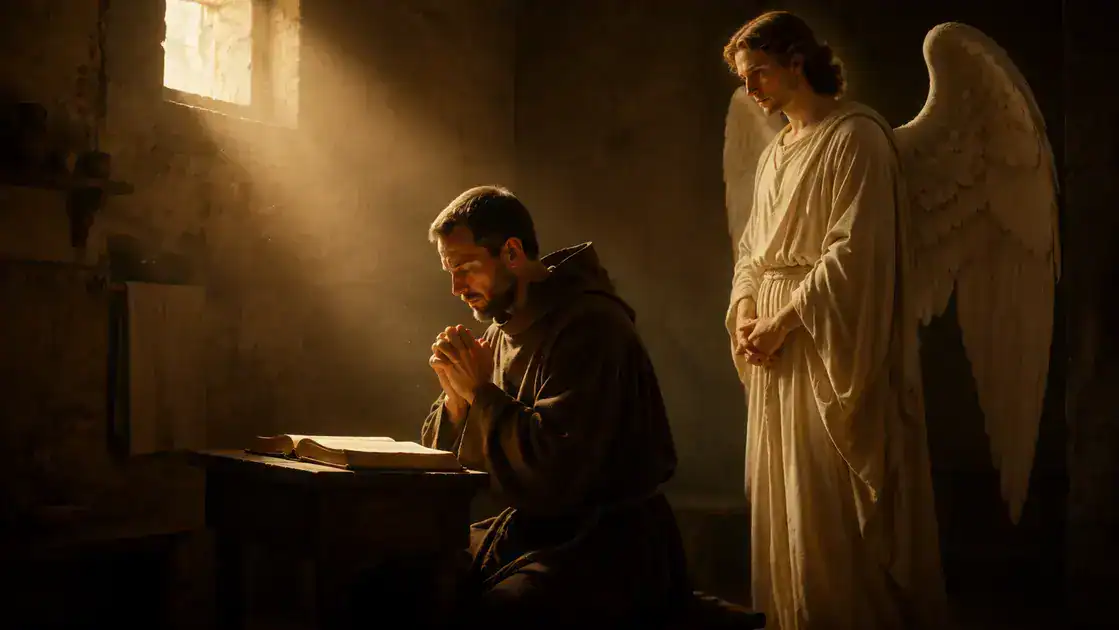
Saints learned to wait in small, ordinary places. St. Benedict begins his rule with the call Listen, O my son, and that simple command shaped a life of attention. Teresa of Avila described prayer as moving through inner rooms where listening becomes the main skill. Their stories show that listening is a formed habit, not a passive mood, and it opens a quiet door where God can speak.
They practiced habits that quieted the rush of the day. Ignatius of Loyola taught the examen, a brief pause to notice where God was present, which trains the heart to hear the whisper beneath work and worry. John of the Cross showed how silence removes the clutter that keeps us from receiving grace, and many monastics learned to hold a single attention—breath, scripture phrase, or the simple awareness of God’s nearness.
These encounters invite a gentle experiment: short, repeated practices that teach the ear to recognize the holy in daily life. Begin with two minutes of stillness, name one gratitude or one need, and listen without rushing. Over time that habit changes how you move through the afternoon—small signs become clearer, decisions feel steadier, and the presence that the saints spoke of becomes a trusted companion.
Practices to carry angelic presence into the afternoon
Begin with very small practices that fit into your afternoon. Pause for a slow breath, place a hand lightly over your heart, and name a short phrase such as “You are with me”. These tiny gestures are like a cord that reminds you of companionship; they do not demand long time, only steady return. Over days, the habit rewires the moment so that ordinary tasks can feel watched over and held.
Choose two or three simple signs that work for you: a quiet bow of the head, a brief blessing of your food, or a single verse from the psalms repeated once or twice. Rooting the practice in the body—touch, posture, or a breath pattern—helps the spirit remember when thoughts scatter. The saints teach that regular, small acts train the heart to hear, and these gestures become channels for that gentle listening.
Finally, make the practice repeatable: set a soft cue like the chime of a clock or the closing of an email, and use it to return to a two-minute pause. In that short time imagine a steady presence beside you, breathe with intention, and offer one grateful line. With patience these minutes accumulate, and the afternoon grows framed by a calm that feels less like an idea and more like a faithful companion at your side.
A closing blessing for your afternoon pause
Breathe once more and notice the quiet that remains. In this small space, imagine the gentle company of angels near you, not to startle but to steady.
They do not erase your tasks or trouble. Instead they make the ordinary luminous. Remember that this is not a feeling you must chase; it is a presence you can return to. You are held and guided in the steady rhythm of each breath.
Carry one small practice with you: a two-minute pause, a short verse, or a hand over your heart when the day feels heavy. These tiny acts teach the soul to listen and to trust the sacred in the ordinary.
May this pause leave you calm, curious, and brave. Go gently into your afternoon with wonder and the quiet companionship of the angels.
FAQ – Common questions about afternoon pauses with angels and sacred presence
Do guardian angels truly watch over us according to Scripture?
Yes. Scripture speaks of angelic care (Psalm 91:11; Psalm 34:7) and Jesus alludes to angels of children in Matthew 18:10. Hebrews 1:14 calls angels “ministering spirits,” which Christian tradition has long read as a promise of faithful companionship.
How do angels usually appear in the Bible?
Their appearances vary: sometimes as ordinary travelers (Abraham’s visitors), in dreams (Daniel), or as radiant messengers (Gabriel to Zechariah and Mary in Luke 1). The differing images show that angels meet people in ways suited to the moment rather than by one fixed shape.
Can I speak to my guardian angel in prayer?
Many faithful traditions encourage a simple address to your guardian angel as a way to name companionship, while directing ultimate prayer to God. Saints and devotional practice model brief, humble words to an angelic companion, always keeping God as the center of worship.
How can I tell God’s guidance from my own imagination?
Test what you hear by Scripture and by its fruits: does it lead to love, humility, and service? 1 John 4:1 urges testing the spirits, and the community and tradition can offer wise counsel; genuine guidance will not contradict the Gospel or produce selfish anxiety.
What short practices invite angelic presence into my afternoon?
Use tiny, repeatable acts: a two-minute pause with slow breaths, a short Psalm phrase like “He leads me beside still waters,” a hand over the heart, or a brief examen. These habits, grounded in Scripture and the saints’ witness, train the heart to notice the holy in ordinary time.
What is the difference between archangels and guardian angels?
Archangels like Michael and Gabriel appear with broad missions in Scripture (Daniel, Luke; Michael also in Jude), while guardian angels are described in tradition as companions assigned to individual souls (see Matthew 18:10). The archangels act in key moments of God’s plan; guardian angels attend daily personal life.