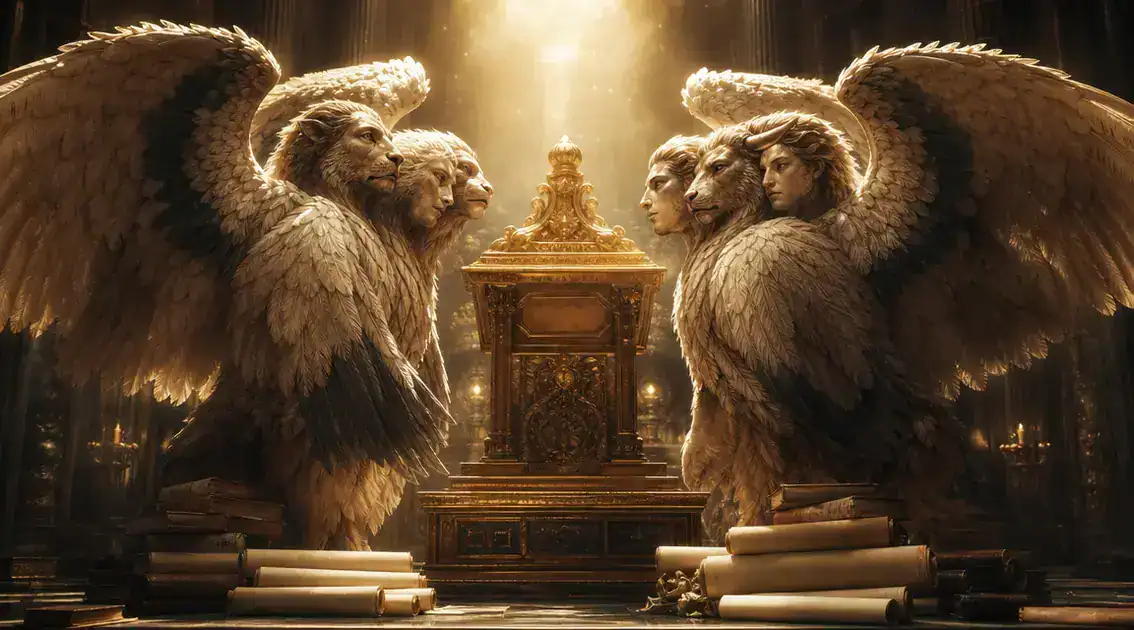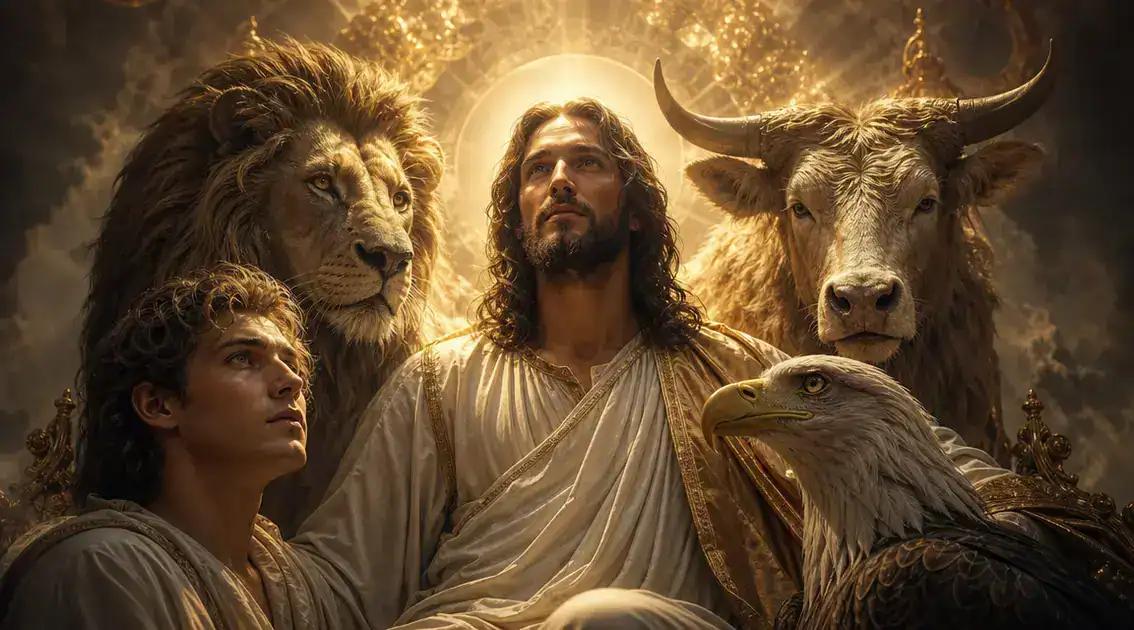

Cherubim four faces meaning: the four faces—man, lion, ox, and eagle—symbolize the fullness of God’s presence and action: human reason and relationship, royal courage, faithful service, and swift prophetic vision, serving as liturgical attendants of the divine throne that instruct and shape prayerful life toward Christ.
Have you ever wondered about cherubim four faces meaning? In Ezekiel’s burning vision these four faces—man, lion, ox, eagle—feel like a living language from God, calling us to listen more closely.
Ezekiel’s vision: the context and startling imagery
Ezekiel’s vision opens like a startling scene where heaven touches an ordinary riverbank. The prophet stands among exiles when a brilliant wind and a living figure appear, and the air itself seems charged with meaning. The language is vivid and strange so that the heart leans in even as the mind reaches for sense.
At the center are the four living creatures, each bearing four faces: a man, a lion, an ox, and an eagle. Beside them are wheels within wheels, full of eyes, and a brightness like burning metal moves through the vision. These images are not merely decorative; they point to God’s knowledge, strength, service, and swiftness toward the world.
To read this scene devotionally is to let awe shape our prayer. The vision comforts those who feel exiled by showing a God who moves toward them with power and care. Let the strange imagery invite a listening heart that accepts mystery and waits for the quiet call to follow.
The four faces explained: man, lion, ox, and eagle
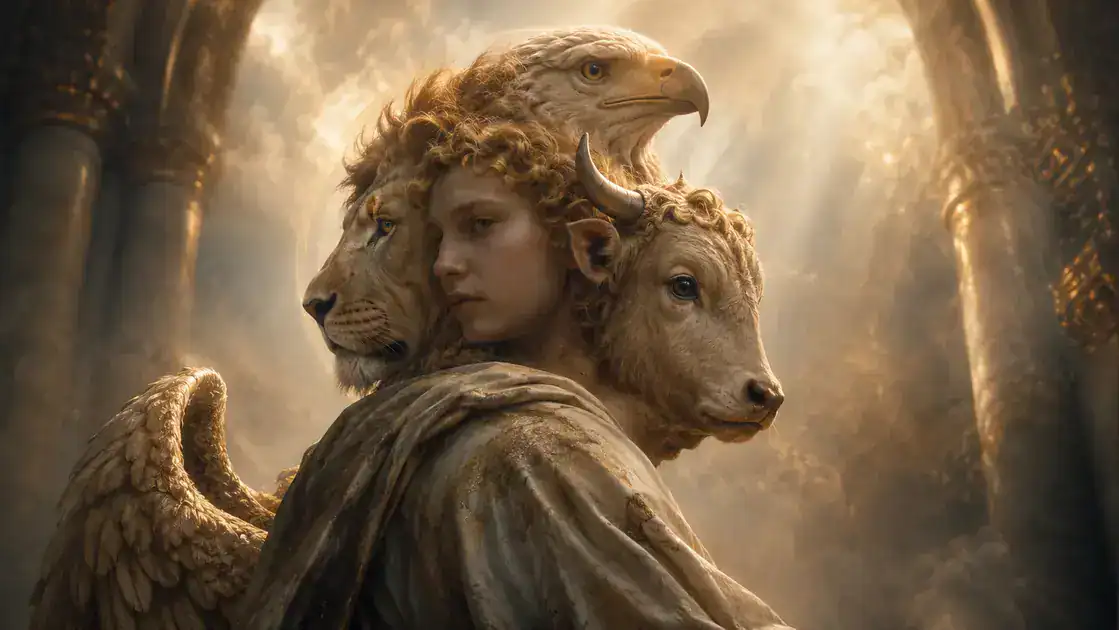
The cherubim’s four faces—man, lion, ox, and eagle—read like a simple, living catechism. Each face names a way God reaches us: the man invites reason and relationship, the lion calls forth courage and protection, the ox shows gentle, steady service, and the eagle lifts the heart toward heavenly sight. These images are vivid but easy to hold in the mind as parts of a whole.
Scripture and tradition tie each face to familiar truths we can touch. The face of the man points to God’s closeness in the human story and the call to wisdom. The face of the lion echoes the Lion of Judah—a royal, protecting power that defends the faithful. The ox recalls temple service and sacrificial labor, the quiet work that keeps worship alive. The eagle brings the prophet’s language of soaring vision, the quick, seeing movement of God toward the world.
In prayer these faces shape a gentle spiritual practice. Let the man teach you attention and honest thought; let the lion give you steadiness in trials; let the ox draw you into faithful, humble work; let the eagle widen your gaze and trust in God’s speed. Hold one face in quiet reflection and then another, allowing each to form a balanced life of thought, courage, service, and hope.
Symbolic layers: attributes, roles, and prophetic voice
When we look at the cherubim more closely we see overlapping attributes rather than separate parts. The face of the man brings intelligence and relationship, the lion brings strength and kingship, the ox brings steady service, and the eagle brings clear sight and swiftness. These qualities sit together so that each face lends its gift to the whole, like four instruments in one quiet song.
From these attributes arise clear roles in the vision. The cherubim guard and surround the throne, stand as ministers of worship, and move as the living presence of God toward a world in need. The wheels full of eyes speak of knowing and seeing; the wings and motion speak of going where God sends. In this way the images point to what the creatures do, not only what they are.
Finally, the cherubim offer a prophetic voice that is more felt than spoken. Their shapes, movement, and light call us to attention, to a kind of listening that reads symbol and action instead of words. In prayer one can attend to which face seems nearest—asking quietly for understanding, courage, service, or vision—and let that sense shape humble response to God in the day ahead.
Cherubim in temple worship and divine presence

In Israel’s worship the cherubim sit at the heart of sacred space. Skilled hands shaped two golden cherubim to stand facing one another above the Ark, and together they formed the mercy seat. This was not mere ornament. The Bible names the inner room the Holy of Holies, the very center where heaven and earth meet in worship.
The cherubim serve as more than a throne decoration; they mark the place of meeting. Between their wings the text suggests God draws near to his people, and the priests minister at the veil with incense and careful rites. The images teach that true worship brings us into the company of the divine, where humility and care matter most. In that posture, the worshiping community learns to expect God’s nearness, not distant rule.
Today those images can shape how we pray and gather. When we enter church, light a candle, or bow in silence, we are remembering a God who meets us in a holy space. We can let each face of the cherubim call us to a different response—reason, courage, service, sight—so that worship becomes steady and whole. For Christians, this meeting finds its fullest expression in Christ, who gathers a living people and makes a dwelling place of their hearts.
Patristic and medieval interpretations: from Augustine to Aquinas
Early church writers read Ezekiel not as a puzzle to be solved but as a living message for the soul. Fathers like Augustine offered a simple guide: Scripture speaks on many levels—literal, moral, and spiritual—and the strange cherubic images invited an inner, allegorical hearing more than a dry diagram. That way of reading kept the vision close to prayer and to the daily life of the faithful.
By the later patristic period and into the Middle Ages, thinkers such as Pseudo‑Dionysius and monastic teachers shaped a more mystical lens. They described the cherubim as signs of divine knowing and nearness, models for those who seek contemplative prayer. Aquinas and medieval theologians drew these strands together, treating cherubim in the study of angels as nearer to God and as symbols of the intellect lifted toward divine truth.
These traditions help us use the vision devotionally today. Read each face as a gentle invitation: attend with the mind, stand with courage, serve with steady hands, and lift your sight toward what is beyond. Let the patristic and medieval readings move you from curiosity into practice, where the text becomes a companion on the path to Christ and to quiet transformation.
Practical devotion: encountering the cherubim in prayer
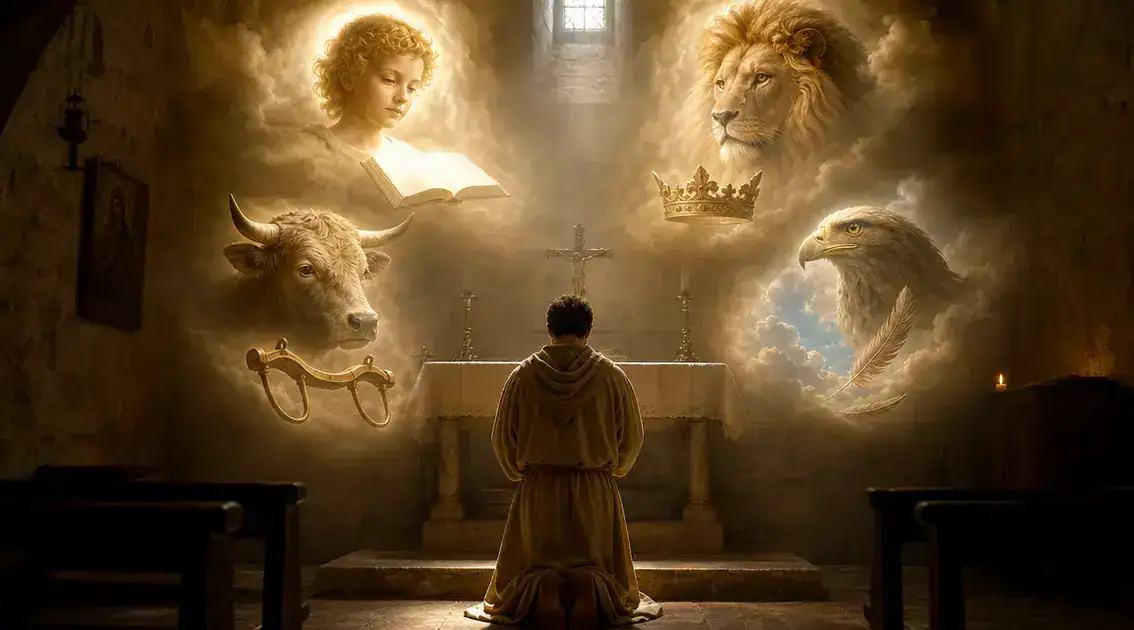
One gentle way to bring the cherubim into prayer is to let each face guide a short breath prayer. Sit quietly and picture the scene from Ezekiel for a moment, breathe in slowly, and bring to mind the face of the man. Ask for clear thought and honest relationship with God, then pause and listen. Keep the language simple—one line or a few words is enough.
Move on to the lion, asking for courage and steady heart, and then to the ox for faithful service in daily tasks. Finish that turn by turning your gaze upward to the eagle, asking for vision and trust in God’s horizon. Use short, steady phrases or a Scripture line for each. The practice trains the soul to name what it needs and to receive guidance in small, practical steps.
Try this for five quiet minutes each day or once a week as a focused pause. Carry one face into your work or a hard conversation—let the man bring wise words, the lion bring courage, the ox steady care, the eagle wide sight. Remember that this simple devotion points us toward Christ, who gathers wisdom, strength, service, and vision into a single, living way of following.
How the cherubim’s faces speak to modern spiritual life
The cherubim’s faces remain surprisingly close to ordinary hearts and days. In a hurried life, these images invite a slow, careful gaze: the human face calls us back to honest relationship and clear thought, the lion asks for steady courage in small struggles, the ox reminds us that faithful service is sacred, and the eagle widens our view toward hope. Each face names a gift we can practice in prayer, work, and family life.
Practically, you can use the faces as brief spiritual checks. Pause before a meeting and ask the man for wise words. Enter a hard task with the lion for quiet courage. Take up daily chores with the ox as a form of prayer, and end the day with the eagle to lift your heart toward God’s horizon. These small acts train the soul to balance thought, courage, service, and vision without needing special experiences.
Over time such practices shape a steady, holy rhythm. They help you bring prayer into the ordinary and see God at work in simple duties and bold steps alike. Let the faces point you toward Christ, who gathers all these virtues into a single life, and let that gathered life become the gentle witness you bring to others each day.
A closing prayer
As we leave this vision, may the cherubim guard our minds and hearts. May the face of the man teach us wisdom, the lion steady our courage, the ox bless our faithfulness, and the eagle widen our sight.
Help us carry these gifts into ordinary moments. Let our work, words, and small acts become ways to honor God. Teach us to pray with simple trust and steady hands.
Keep us near to Christ, the meeting place of heaven and earth. May wonder and peace follow our steps, and may our lives point others to God’s gentle presence each day.
FAQ – Understanding the cherubim and their meaning
What do the four faces of the cherubim mean?
The four faces—man, lion, ox, and eagle—appear in Ezekiel (chapters 1 and 10) and are read by tradition as complementary ways God reaches us: man for relationship and reason, lion for royal strength and courage, ox for faithful service, and eagle for swift, far‑seeing vision. The New Testament image of four living creatures in Revelation 4:6–8 echoes this language, and the church fathers read these faces devotionally as calls to a whole life of prayer and action.
Are cherubim the same as guardian angels?
Not exactly. Scripture and Christian tradition treat cherubim as a high order of angelic beings associated with God’s throne and the sanctuary (see Exodus 25:18–22; Ezekiel 1, 10). Guardian angels are described in Scripture as personal protectors (e.g., Matthew 18:10). Both are part of the heavenly household, but cherubim function liturgically and symbolically as attendants of divine presence rather than individual guardians of a single person.
Was Ezekiel’s vision literal or symbolic?
Ezekiel’s account is a prophetic vision that uses vivid, symbolic language to convey spiritual truths. The text combines sensory detail and heavenly symbolism so readers may enter the mystery rather than solve a simple diagram. Church interpreters from Augustine to the mystics treated the vision as a real, revelatory encounter that communicates who God is and how God acts, even when the forms remain mysterious.
How can I use the cherubim’s imagery in prayer or devotion?
Use the faces as short, focused guides in prayer—invite the human face for wisdom, the lion for courage, the ox for faithful service, and the eagle for enlarged sight. Simple breath prayers, brief meditations on a face before work, or a five‑minute evening reflection can root daily life in worship. Tradition points us ultimately to Christ as the meeting place of heaven and earth, so these practices lead us deeper into communion with him.
Do other Bible passages describe similar creatures?
Yes. Revelation 4:6–8 describes four living creatures around God’s throne with similar motifs. Exodus places golden cherubim above the Ark (Exodus 25:18–22), marking God’s dwelling among his people. These recurring images show a biblical pattern: creatures symbolize God’s character and the way heavenly life relates to our worship.
What does it mean that the cherubim have a prophetic voice today?
Their prophetic voice is an invitation to attention and transformation. The cherubim’s gestures and faces call us to know (mind), dare (courage), serve (faithful work), and see (hopeful vision). In modern life that voice urges practical holiness—thoughtful choices, steady service, courageous love, and trust in God’s horizon—rooted in Scripture and the long Christian tradition.