

angel appears to mary annunciation is the Gospel account in Luke where the archangel Gabriel announces by name and spirit that God will become human, prompting Mary’s humble consent (the fiat), which theologians see as the moment human freedom cooperates with divine grace to begin the Incarnation and salvation history.
Have you ever paused before the hush of the Annunciation — and wondered how angel appears to mary annunciation feels, the soft light, Gabriel’s quiet words that invite trust?
Gabriel’s message in Luke: reading the biblical text
Open the Gospel of Luke and you meet a moment of quiet power: an angel arrives with a greeting that changes everything. In Luke 1:26–38, the messenger speaks clearly and tenderly, announcing a promise that will bring new life into the world. This is not a lofty sermon but a simple, intimate exchange — Gabriel’s greeting meets a young woman in her ordinary home, and the sacred enters the everyday.
Mary listens, asks a plain question, and hears how God will act by the Spirit. Her response is careful and open, a conversation that shows faith and attention rather than flashy proof. When we slow down with this text, the rhythm of the scene becomes clear: word, wonder, question, and then trust. Notably, the message names a purpose beyond herself, pointing to God’s plan for humanity as much as to Mary’s own role.
Reading Luke this way invites us into a devotional practice: linger over the phrases, imagine the light through the window, and let the angel’s words land in your heart. Try reading the passage aloud slowly, then sit in silence and let one phrase echo. In that quiet, the text often becomes more than information — it becomes an invitation to say, like Mary, a humble and trusting yes.
Mary’s fiat: theological meaning of her yes

When the angel’s words reach Mary, she answers with a single, humble word: a yes the Church calls the fiat. This yes is quiet but decisive. It is not a snap decision or an unthinking obedience, but a clear consent that lets God work through her simple life.
Theological tradition sees the fiat as the place where human freedom and divine grace meet. Mary’s consent does not make God act; rather, it opens human cooperation to God’s loving plan. In that opening, the Incarnation takes flesh—God entering history through a receptive human heart.
For our own journey, Mary’s yes offers a gentle model: notice the small moments where you can choose trust over fear and service over comfort. Practice a short listening prayer, then offer one modest act as a willing gift. Over time, these small yeses shape a life that, like Mary’s, becomes a dwelling for grace.
Symbols in the annunciation: lilies, light and the greeting
Many images of the Annunciation gather three quiet symbols: lilies, light, and the angel’s greeting. Each of these speaks without loud words, offering a simple way to read the mystery with the heart. When we learn their language, the scene becomes a gentle lesson about how God meets ordinary life.
White lilies often rest near Mary, their pale petals folded like a soft prayer. Artists chose them to point to purity, humble service, and the promise of new life that will come through her. These flowers remind us that holiness can look ordinary and still hold great meaning.
Light in the room does more than show form; it acts as a sign of divine presence, a warm glow that makes the ordinary sacred. Gabriel’s greeting, the tender words that name Mary’s favor, invites a response and opens a space for grace. Reading these symbols together helps us hear the message again: God comes close through humble signs and asks for a trusting yes.
How early Christians and saints cherished the annunciation
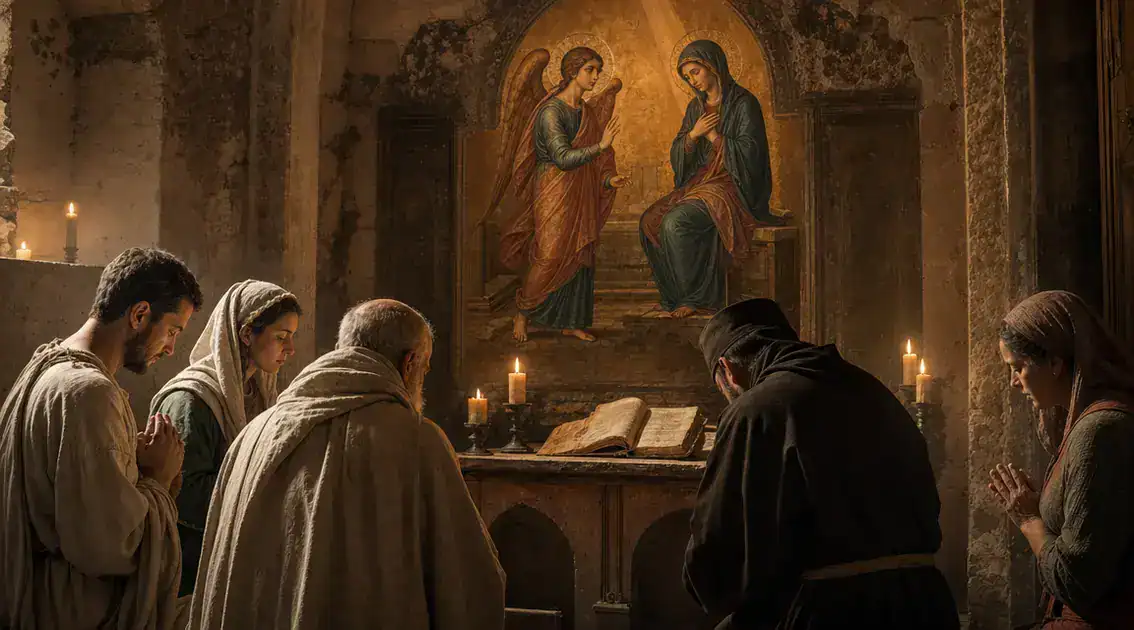
From the earliest days the Church held the Annunciation as a quiet center of prayer. Communities marked March 25 as a day to remember how God chose to enter human life, and artists and hymnwriters turned the scene into a living prayer. In homes and basilicas, images of the angel and Mary became windows for devotion, helping believers look beyond words to the sacred encounter itself.
Saints and teachers across the ages found in the story a model of humble listening and faithful response. The angel’s greeting and Elizabeth’s reply later shaped the prayer we know as the Hail Mary, while monks and parish communities used chants, icons, and simple acts of reverence to keep the moment alive. For many saints, Mary’s posture of attentive trust stood as a guide for prayer and service, not an abstract idea but a form of daily living.
That long tradition invites us still: to pause, to pray, and to let art and liturgy form our hearts. Lighting a candle before an image, reading the Luke passage slowly, or simply making a short, quiet yes in the morning are small ways to join the great stream of devotion. These practices remind us that the Annunciation is not only a past event but a present call to welcome God’s presence in ordinary life.
Praying the annunciation today: devotion for decision and trust
When a choice feels heavy, you can turn to the Annunciation as a short prayer. Sit quietly for a minute, breathe slowly, and read or speak one simple line from Luke about the angel’s greeting. Let the words sink in and make space for the small stirrings of your heart.
Try a practice that fits your day: read a single phrase slowly, hold it in your mind, and offer a short answer of trust. This can be as simple as a whispered yes or a steady breath that speaks, “I will trust.” Keep the practice brief and regular so that these small acts become a habit of listening and responding.
Over time, those tiny choices shape how you meet bigger decisions; each small consent builds a trusting pattern. When doubt comes, return to the image of Mary pausing and saying fiat—a willing opening to God’s work in life. Let that memory steady you as you decide, offering each choice as a quiet prayer of trust.
A gentle prayer from the Annunciation
May we learn to listen like Mary, to notice the quiet voice that calls us into life. In those small, still moments, may our hearts open and offer a simple fiat — a willing yes that welcomes grace.
May the memory of the angel’s greeting bring calm to anxious choices and light to dim days. Let the image of lilies and soft light remind us that holiness often comes through humble things and ordinary acts.
Practice one small yes each morning: a brief prayer, a kind act, a steady breath offered with trust. These tiny choices shape us over time and make space for God to work in our lives.
Go now with peace and wonder. May you carry the Annunciation in your pocket of silence and return to it when you need courage. Amen.
FAQ – Common questions about the Annunciation and its spiritual meaning
What exactly happened when the angel appeared to Mary in the Annunciation?
In Luke 1:26–38 an angel, called Gabriel, greets Mary and announces that she will bear a son by the power of the Holy Spirit. The scene is a quiet, personal exchange: a message, Mary’s question, and her consenting yes. Tradition sees this as the moment the Incarnation was prepared in a human heart, when God’s plan for saving the world began to take flesh.
Why is Gabriel called an archangel and what is his role in Scripture?
Gabriel appears by name in Luke and in the book of Daniel as a heavenly messenger sent to explain God’s plan (see Daniel 8–9; Luke 1). The title archangel highlights a special role among angels as a messenger for important revelations. His mission in the Annunciation is to bring God’s decisive word to Mary, not to overshadow her freedom but to invite her cooperation.
What does Mary’s word “fiat” mean, and why is it important?
“Fiat” is Latin for Mary’s simple, trusting answer: “Let it be done” (Luke 1:38). The Church honors this as a model of faithful consent: Mary freely opens herself to God’s will. Theologically, her yes cooperates with grace—she does not create salvation, but she allows God’s work to be born in the human story.
How is the Annunciation used in prayer and worship today?
The Annunciation is remembered liturgically on March 25 and appears in prayers like the Angelus and the Hail Mary, which draw on Luke’s words. Many Christians use the scene for short daily devotions: slow reading of Luke 1, a brief spoken yes in prayer, lighting a candle, or meditating on Mary’s listening as a way to grow in attentiveness and trust.
What do lilies and light symbolize in pictures of the Annunciation?
Artists often use white lilies to suggest purity, humility, and new life, and light to signify God’s presence and action. These are devotional signs, not proofs: they help the viewer enter the scene’s spiritual meaning, reminding us that God often comes through humble, ordinary things that we can recognize with prayerful attention.
How can I imitate Mary’s response in my own life when facing hard decisions?
Begin with a short practice: read a phrase of Luke’s Annunciation slowly, breathe, and offer a simple, honest yes or trust. Make small, regular acts of consent—helping another, offering time in prayer, or choosing service over comfort. Over time these small yeses form a habit of openness, helping you meet larger choices with calm and faith.